
Asana Alternatives for Website Launch Coordination
A practical roundup of Asana alternatives for agencies coordinating website launches, including when to use broad PM tools, spreadsheets, databases, and Shipperly.
 Shipperly Team
Written by Shipperly Team. The Shipperly editorial team writes for website agencies coordinating client-owned launch work, safe access paths, blockers, AI-assisted follow-up drafts, and final approval workflows.
Quick answer
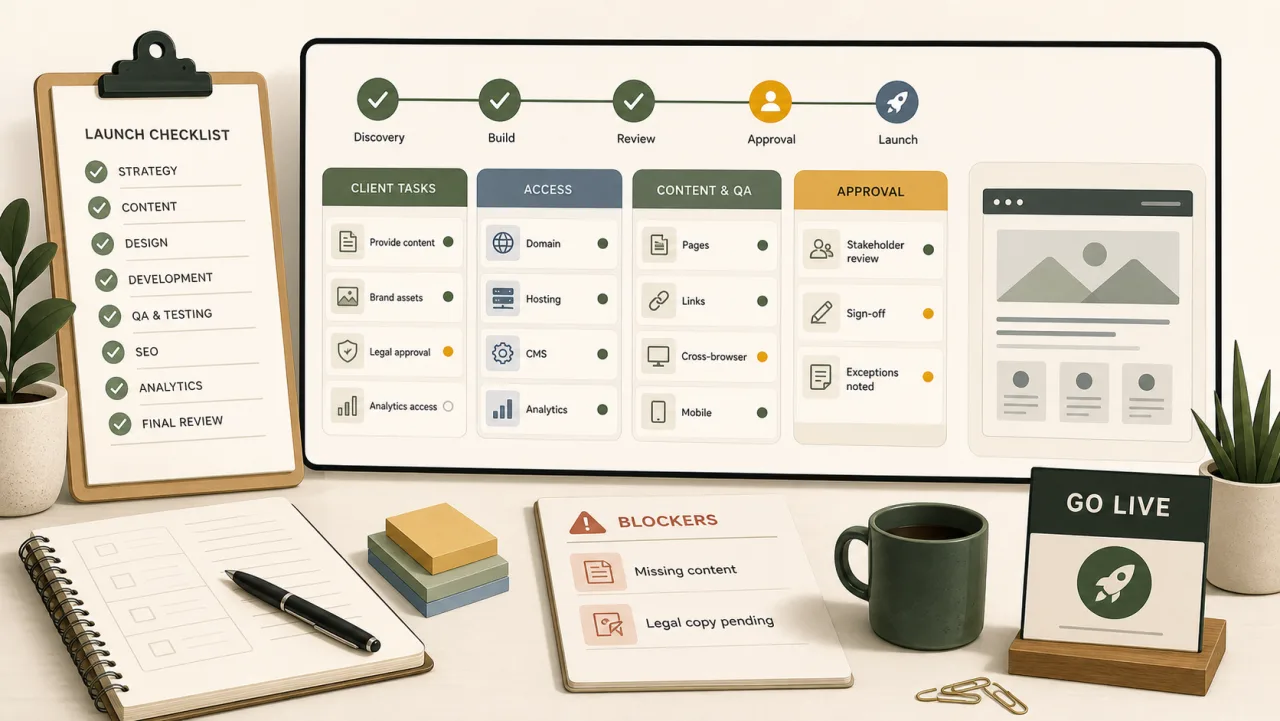
The best Asana alternative for website launch coordination depends on which workflow is failing. If your agency needs broad project management, compare tools such as ClickUp, monday.com, Teamwork, Wrike, Trello, Basecamp, Jira, Notion, Airtable, and spreadsheets. If the bottleneck is client-owned launch work, Shipperly is the specialist: it gives clients a focused launch action portal for requests, blockers, safe access actions, AI-assisted follow-up drafts, readiness review, and final approval. This matters most for website agencies where the internal build is organized but launch still depends on clients confirming DNS, content, legal review, form routing, stakeholder ownership, or go-live approval. The exception: keep Asana or another PM system when you need one internal operating system for every agency project.
Best for
Website agency owners, project managers, producers, account managers, and launch coordinators who are comparing Asana alternatives because client launch work is still scattered across email, spreadsheets, comments, and meetings.
What to do next
- Decide whether you need a broad project management replacement or a launch-readiness layer.
- Keep internal agency production in the tool your team already uses well.
- Move client-owned launch tasks into a workflow clients can understand without seeing the whole agency board.
- Compare tools by primary job, client experience, blocker visibility, safe access handling, and approval workflow.
- Avoid choosing a tool only because it has more fields, views, or automations than your current project board.
Shipperly workflow: Shipperly is the specialist option in this roundup. It is not a full Asana replacement. It is an AI launch coordinator for website agencies that need client-owned requests, blockers, safe access guidance, agency-reviewed AI follow-up drafts, readiness review, and final launch approval in one client-facing workflow.
Start with the real reason Asana is not enough
"Asana alternative" is a broad search. Some teams mean they need a different internal project management system. Others mean the agency's internal board is fine, but it does not work for clients during launch week.
Those are different problems.
If the agency team is struggling with workload, dependencies, recurring retainers, task templates, editorial planning, or internal visibility, then a broad PM alternative may be the right category. Compare general tools and choose the one that fits how your team plans work.
If the agency team is organized internally but still loses time chasing client-side launch tasks, the better category is website launch coordination. In that case, replacing Asana may not solve the real problem. The client still needs a clearer way to finish their part of the launch.
Website launch coordination has different requirements:
- Client-owned tasks need named owners.
- Client stakeholders need simple access.
- Access requests need safer guidance.
- Blockers need launch impact, not just a status label.
- AI follow-up drafts need agency review.
- Readiness needs to account for overdue, unassigned, blocked, and approval-sensitive work.
- Final approval needs a clear operational record.
A broad PM tool can hold this information. A launch-specific workflow makes it easier for clients and agencies to act on it.
Comparison table: Asana alternatives for launch coordination
This table is not a universal ranking. It compares common categories and tools by the job they are usually asked to do during website launch work.
| Tool or category | Best for | Where it can struggle during launch | How it fits with Shipperly |
|---|---|---|---|
| Shipperly | Client-facing website launch readiness, blockers, safe access, AI launch briefs, follow-up drafts, and final approval | Not a full internal PM suite, file store, credential vault, or legal e-signature system | Use as the launch readiness layer for client-owned work |
| Asana | Broad internal project management, tasks, timelines, and team workflows | Clients may not need the full agency board during launch week | Keep Asana internally and use Shipperly for client launch actions |
| ClickUp | Broad work management and configurable internal operations | Configuration can become more than a client needs for a narrow launch handoff | Use for internal operations; use Shipperly for focused client readiness |
| monday.com | Visual work tracking and team process dashboards | A broad board may still require client training or agency mediation | Pair with Shipperly when clients need a simpler launch portal |
| Teamwork | Agency-oriented project and client work management | Client launch approval and safe access may still need a specific process | Use Shipperly for the final client-side launch workflow |
| Trello | Lightweight boards and simple visual task tracking | Launch risk can hide behind cards, labels, and comments | Use Trello for simple internal boards; use Shipperly for readiness and approval |
| Basecamp | Client communication and project organization | Launch-critical ownership, blockers, and readiness can still be hard to separate | Use Shipperly when client actions need explicit launch impact |
| Wrike | Structured work management for teams with complex internal processes | External launch stakeholders may not need the full operational system | Use Shipperly as a narrow client-facing layer |
| Jira | Technical development workflows and engineering issue tracking | Non-technical client stakeholders usually need a simpler launch action view | Keep Jira for engineering; use Shipperly for client launch requests |
| Notion | Flexible docs, wikis, lightweight databases, and templates | It may require manual upkeep to become a daily launch readiness system | Use Notion for documentation; use Shipperly for active launch coordination |
| Airtable | Structured data, custom trackers, and flexible launch inventories | The agency may still need to build client experience, follow-up, and approval flow | Use Airtable for inventory or planning; use Shipperly for execution |
| Google Sheets or Excel | Fast planning, checklist drafts, redirect maps, and content inventories | Passive rows do not naturally move blockers, follow-up, access, or approval forward | Keep spreadsheets for planning inputs, then move launch execution into Shipperly |
When Shipperly is the specialist alternative
Shipperly is strongest when the agency is not looking for a bigger task board. It is looking for a clearer launch handoff.
That usually shows up in the final stretch before go-live. The agency has shipped design and development work. QA is close. The client likes the site. But launch is still at risk because someone needs to confirm DNS access, approve legal copy, decide whether a form route is correct, invite the agency into a platform, review a final exception, or give a clear go-live decision.
In a broad PM tool, those items often become ordinary tasks. They may be assigned to "client," discussed in comments, updated after meetings, or copied into follow-up emails. Shipperly turns them into client-owned launch requests with owners, due dates, launch-impact explanations, safe access guidance, comments, blocker state, and approval context.
Use Shipperly when your agency needs:
- A Client Lead who can route client-side requests.
- Magic-link access for client stakeholders.
- A focused needed-from-you view instead of a full agency board.
- Blockers that show why launch is at risk.
- AI Launch Briefs that summarize structured project state.
- Follow-up drafts that an agency user reviews before sending.
- Final launch approval recorded as an operational decision.
Do not choose Shipperly when you need a general platform for every internal task. It is intentionally narrower than that.
When a broad PM alternative is the better answer
Sometimes Asana is not the right PM system for a team, and the team really does need a general replacement.
That may be true when the agency is struggling with:
- Internal task ownership.
- Workload planning.
- Retainer operations.
- Cross-functional dependencies.
- Multiple departments.
- Editorial calendars.
- Product, design, engineering, and marketing work in one place.
- Reporting across many project types.
In those situations, broad PM tools deserve a serious comparison. Shipperly should not be forced into that role. It does not aim to manage every department, sprint, roadmap, recurring task, or internal dependency.
The right architecture for many agencies is a two-layer workflow:
- Internal PM layer: Asana, ClickUp, monday.com, Teamwork, Trello, Basecamp, Wrike, Jira, Notion, Airtable, or another tool your team trusts.
- Launch readiness layer: Shipperly for client-owned launch work, blockers, safe access guidance, AI launch briefs, follow-up drafts, and approval.
That keeps the agency's internal process intact while giving clients a simpler way to finish launch work.
How to choose the right Asana alternative
Use these questions before comparing feature lists.
What job is the tool supposed to own?
If the job is "run the agency," choose a broad PM or work-management tool. If the job is "get client-owned website launch work completed," choose a launch coordination workflow.
Who needs to use it?
Internal agency users can tolerate richer boards, custom fields, dependencies, and status conventions. Client stakeholders usually need a simpler action list. They may only enter the workflow once or twice, so the experience needs to be direct.
What happens when someone is stuck?
During a website launch, "stuck" is not just a mood. It may mean the DNS owner is unknown, legal approval is missing, an access path is unsafe, or a critical form route is untested. The tool should help the agency distinguish ordinary incomplete work from launch blockers.
How does the tool handle access requests?
Website launches often require sensitive systems: domains, hosting, CMS, analytics, CRM, ecommerce, payment settings, and email platforms. The workflow should not ask clients to paste passwords, API keys, recovery codes, SSH keys, private tokens, or payment credentials into a task. Safer options include invitations, temporary accounts, client-admin completion, and secure password managers.
How is final approval recorded?
A comment that says "looks good" may not be enough. The agency needs to know who approved, what they approved, whether blockers remained, whether exceptions were accepted, and whether the approval applied to the current launch scope. Shipperly records approval for operational reference; it does not replace contracts, legal review, or e-signature tools.
Tool-by-tool notes for agency launch work
Shipperly
Choose Shipperly when the agency needs a specialist workflow for client-side launch readiness. It is built around launch requests, Client Lead routing, blockers, safe access guidance, AI Launch Briefs, agency-reviewed follow-up drafts, and final approval.
Shipperly is not the winner of every row. It is not designed to replace all project management, store files, collect credentials, run legal signing, or send AI messages without review. It wins when the problem is narrower: clients need to finish concrete launch actions and the agency needs to know whether the site is ready.
ClickUp, monday.com, Teamwork, Wrike, and similar PM platforms
These tools are usually evaluated as broad work-management systems. They may be a good fit when the agency wants a different internal operating model, more structure, different views, or a more configurable process.
For launch coordination, the question is whether clients will actually use the workflow during the final week. If the client-facing experience still requires heavy agency mediation, a specialist layer may be useful.
Trello, Basecamp, Notion, Airtable, and spreadsheets
These options can be excellent for lightweight planning, documentation, simple boards, trackers, templates, inventories, and shared project context. Many agencies already use one or more of them effectively.
The limitation is usually not that they cannot store launch information. The limitation is that the agency may need to manually maintain ownership, follow-up, blocker severity, access safety, readiness interpretation, and approval records. That manual layer is where launch risk can creep back in.
Jira
Jira can be valuable for engineering and technical delivery workflows. It is usually not the simplest place for a non-technical client stakeholder to understand what the agency needs before go-live.
For website launches, a common pattern is to keep technical work in Jira and use a simpler client-facing workflow for content, access, review, blockers, and approval.
Recommended workflow for agencies
If your agency already has a PM system that the internal team trusts, do not replace it just because the launch handoff is painful.
Try this instead:
- Keep internal production tasks in the current PM tool.
- Identify client-owned launch tasks 5 to 10 business days before target go-live.
- Rewrite vague tasks into clear client requests with owners and due dates.
- Move access-related requests into safer instructions that avoid credential collection.
- Flag blockers separately from ordinary incomplete tasks.
- Use an AI Launch Brief to summarize risk and next best actions for the agency.
- Draft follow-ups for agency review, not automatic sending.
- Request final approval only after readiness context is visible.
- Record the approval decision with approver, timestamp, note, and known exceptions.
This gives the agency a practical division of labor: internal PM for production, Shipperly for the client-side work that can still stop launch.
FAQ
What is the best Asana alternative for website launch coordination?
The best Asana alternative depends on the workflow. Shipperly is the specialist option when the problem is client-facing launch readiness: client-owned tasks, blockers, safe access actions, AI launch briefs, agency-reviewed follow-up drafts, and final approval.
Should agencies replace Asana with Shipperly?
Usually no. Agencies can keep Asana for internal project management and use Shipperly for the external launch readiness layer. That is often cleaner than forcing clients into the agency's internal production board.
What tools should agencies compare besides Shipperly?
Common categories include broad PM tools such as ClickUp, monday.com, Teamwork, Wrike, Trello, Basecamp, and Jira, plus flexible systems such as Notion, Airtable, Google Sheets, and Excel. Compare them by the job they need to own, not only by feature count.
Can Shipperly work with another PM tool?
Yes. Shipperly is designed to sit beside the agency's internal PM system. The agency can keep design, development, QA, and internal production in a tool like Asana while using Shipperly for client-owned launch actions, blockers, readiness review, and final approval.
Is Shipperly a legal e-signature or credential storage tool?
No. Shipperly records final launch approval for operational reference, but it is not a legal e-signature system. It also does not store passwords, API keys, recovery codes, SSH keys, private tokens, payment credentials, or other secrets.
The best Asana alternative is not always a bigger project management platform. For website agencies, the more important question is whether the tool helps the launch actually become ready. If the internal build is organized but client-owned work is still scattered, Shipperly gives that final stretch a clearer workflow.
Related articles
More launch-readiness guidance for agencies.

The Complete Website Launch Coordination Guide for Agencies
A complete website launch coordination guide for agencies, covering ownership, client tasks, blockers, readiness, follow-up, approval, and handoff.
Read article
Shipperly vs. Spreadsheets for Website Launch Tracking
A practical comparison of Shipperly vs. spreadsheets for website launch tracking, including when a spreadsheet is enough and when agencies need a launch-specific workflow.
Read article
Website Launch Handoff Checklist: From Client Approval to Project Completion
A practical website launch handoff checklist for agencies moving from client approval to go-live, post-launch ownership, training, support boundaries, and project completion.
Read article